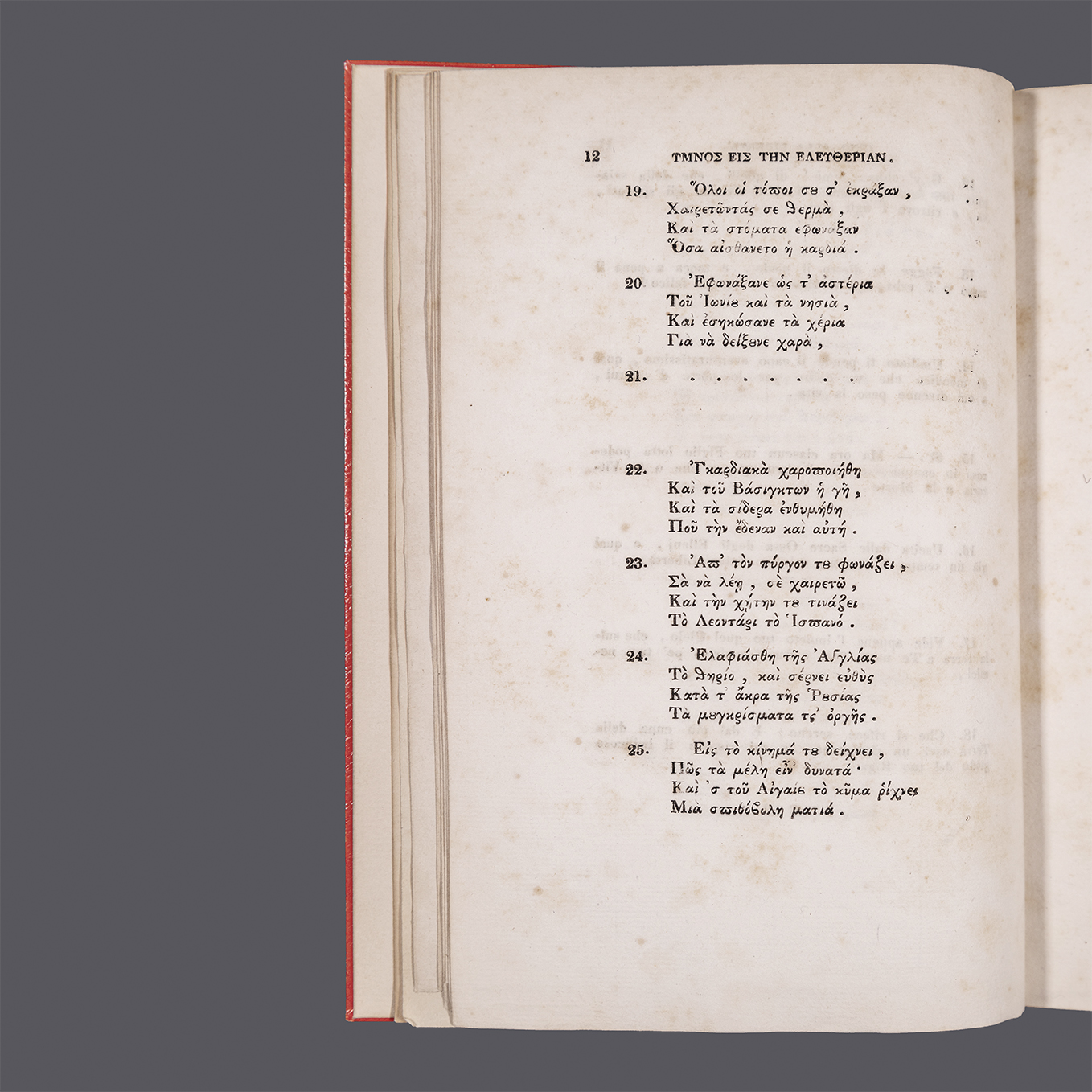
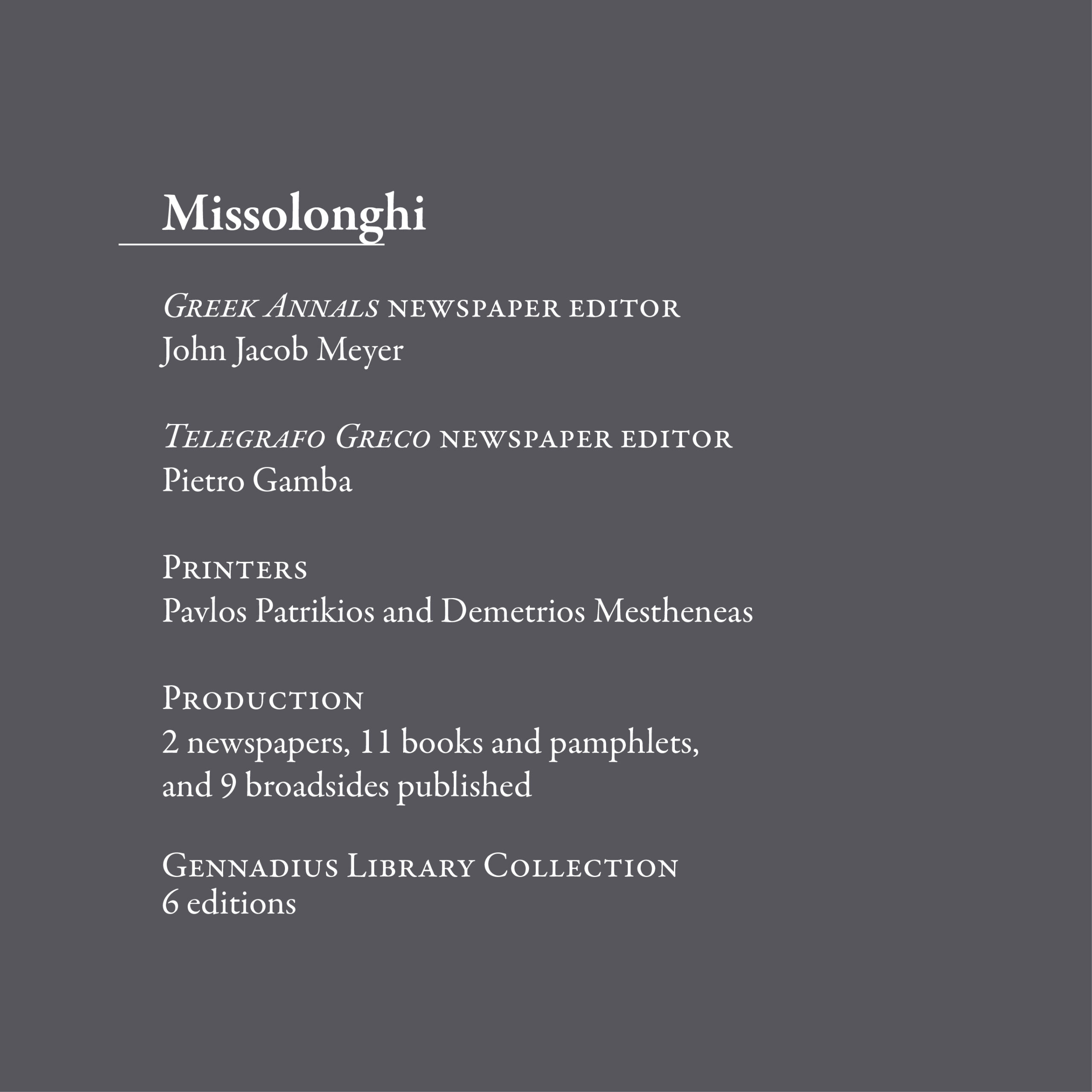
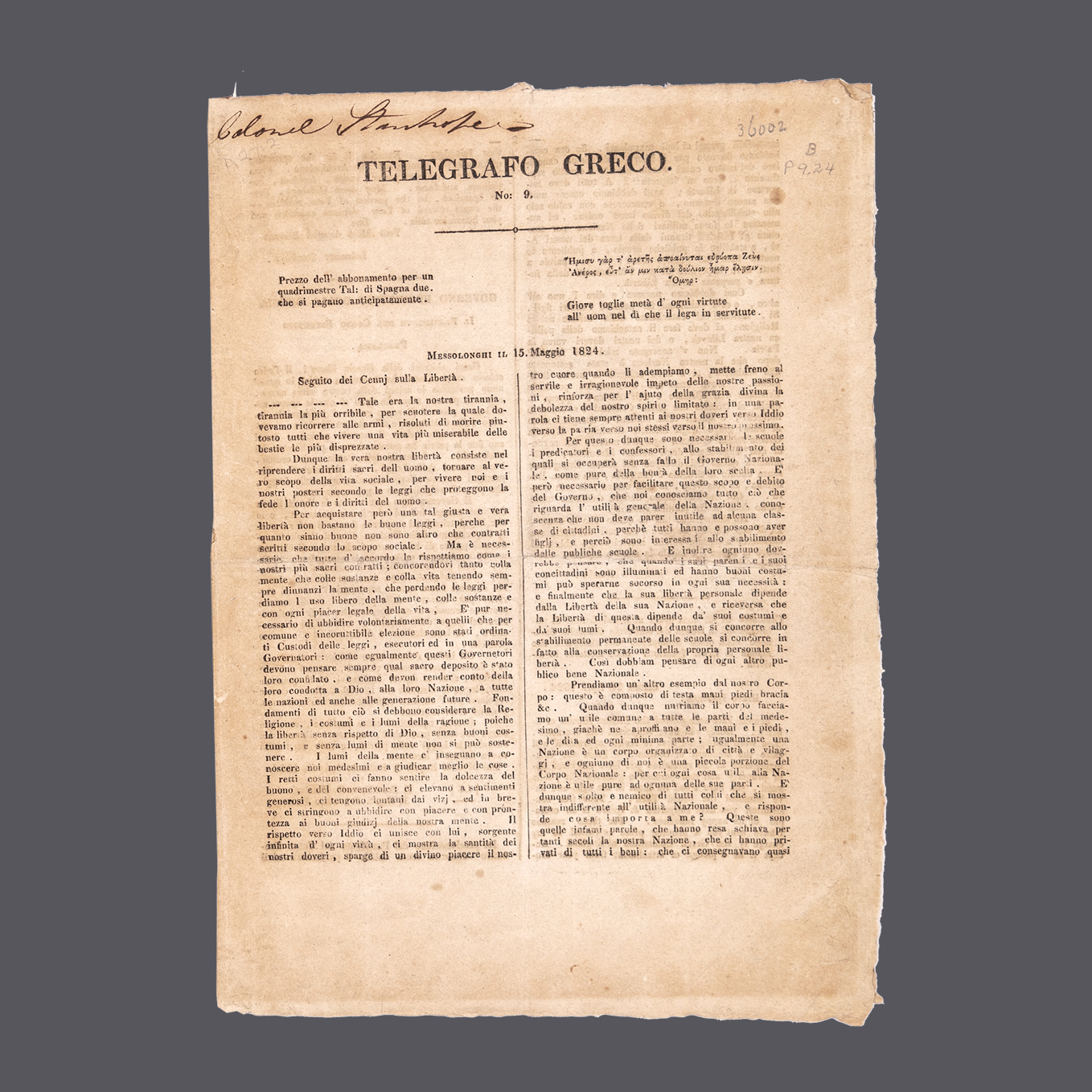
The first attempt to establish a printing house in Missolonghi was made by none other than Alexandros Mavrokordatos. Cognizant of the role printing could play in supporting the revolutionary cause, he brought a press from Pisa in 1821 to Missolonghi, the seat of his administration, known as the Organization of Western Continental Greece (founded on 9 November 1821). In 1823 the representative of the London Philhellenic Committee lieutenant-colonel Leicester Stanhope, brought to Missolonghi four presses, two printing presses and two lithographic presses, to establish a printing house and publish a newspaper. From the outset, the printing house was closely connected with the presence in Missolonghi of the philhellene Lord Byron, who had arrived there together with the Italian philhellene Pietro Gamba. Johann Jacob Meyer was editor of the newspaper Greek Chronicles (Ελληνικά Χρονικά), with Pavlos Patrikios, and subsequently Demetrios Mestheneas, assuming printing duties. Due to the delayed arrival of the presses sent by the Philhellenic Committee, the Greek Chronicles had to be printed in Mavrokordatos’s press and the first issue was published on January 1, 1824. A better outfitted press sent by the Committee arrived soon after. In addition to the Greek Chronicles and the Telegrafo Greco, the Missolonghi printing house also published eleven books and pamphlets as well as nine broadsides, that served administrative needs, presented systems of government, and attempted to provide ideological support to the Revolution as in the case of the publication of Dionysios Solomos’s Hymn to Liberty (Ύμνος εις στην Ελευθερίαν). The Missolonghi publishing house was destroyed during the Exodus.
![Τὰ Ἑλληνικὰ Χρονικὰ [Greek Chronicles]. Missolonghi: J. J. Meyer, 1st January 1824 – 20 February 1826. The 266 issues of the Greek Chronicles were published from 1 January 1824 to 20 February 1826, each issue featuring the Greek translation of Jeremy Bentham’s motto “It is the greatest good to the greatest number of people”, erroneously attributed by the editor to Benjamin Franklin. The newspaper is an invaluable historical source on the final phase of the siege of Missolonghi (1825-1826), as, despite the difficulties, it continued to be published during the siege.](https://greekrevolutionprinting.gr/wp-content/uploads/2022/02/PHOTOS-MESOLOGGI.jpg)
![Issue 29, printed on a black frame, announces the death of Lord Byron in Missolonghi: Missolonghi, 7th (19th) April 1824. All of Greece mourns, in the midst of the joy of Easter, for she has suddenly been deprived of her invaluable benefactor, the Brilliant Lord Noel Byron] Joannes Gennadius noted in his introductory book to his collection that: “Any original number of that journal is now a matter of the greatest rarity.”](https://greekrevolutionprinting.gr/wp-content/uploads/2022/02/PHOTOS-MESOLOGGI1.jpg)
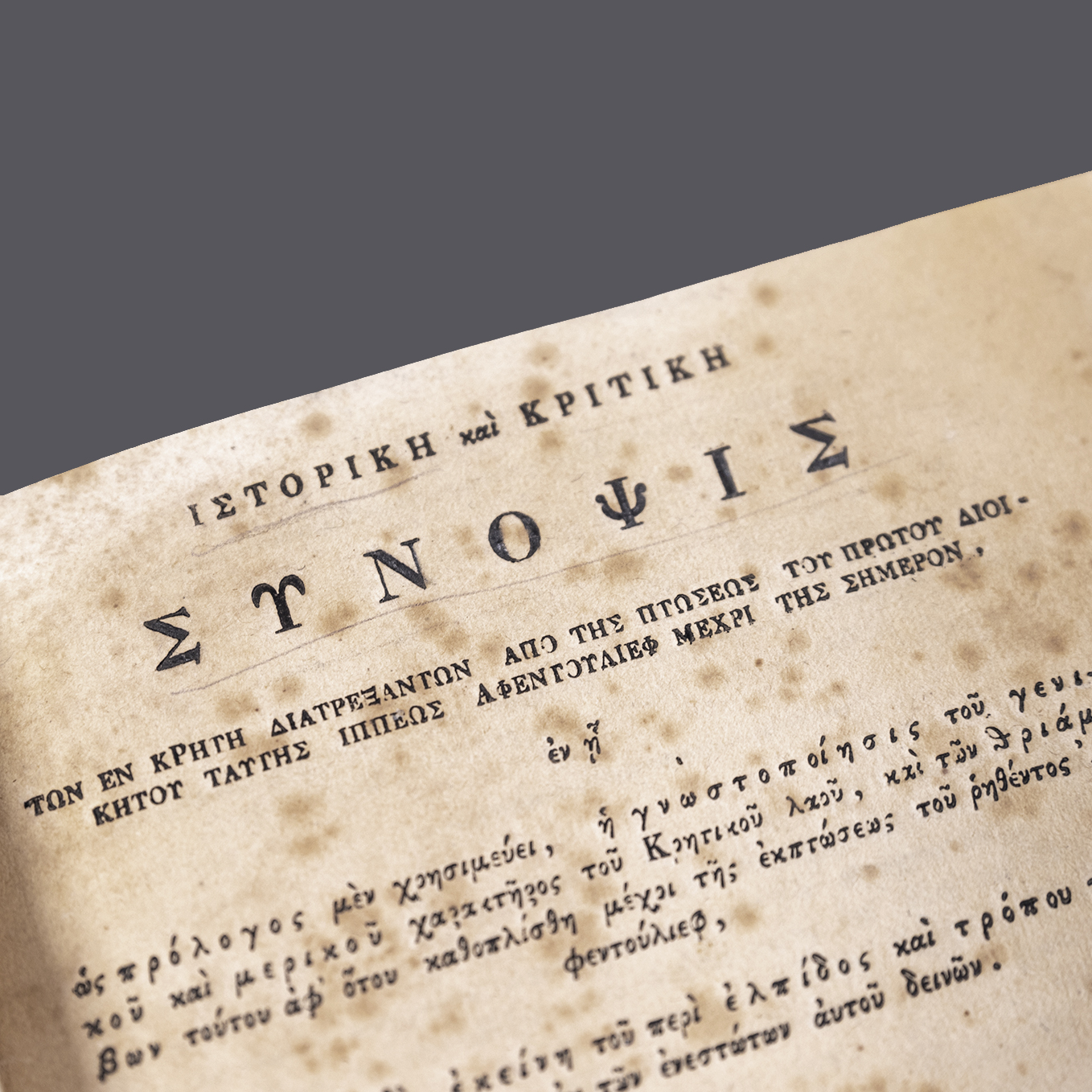
![Ἱστορικὴ καὶ Κριτικὴ Σύνοψις τῶν ἐν Κρήτῃ διατρεξάντων... [Historical and Critical Summary of events in Crete from the fall of the first governor, Afentoulief, to the present. In lieu of prologue, an account of the character of the Cretan people by] … P. Nicolaidis, … Missolonghi, Printing House of Demetrius Mestheneus. 1824.](https://greekrevolutionprinting.gr/wp-content/uploads/2022/02/PHOTOS-MESOLOGGI3.jpg)
![Προσωρινὸν Πολίτευμα τῆς Ἑλλάδος. [Provisional Regime of Greece, and organizational plan of its provinces. Both amended and ratified by the Second National Legislative Assembly of the Greeks at Astros. These are followed by the Political Constitutions of the United Kingdom and the United States of America]… translated by A. Polyzoidis. Printed for the first time by D. Mestheneas at his own expense. For the public use and benefit of all Greeks. Missolonghi 1824. Second edition of the revised 1822 Constitution (first edition published in Hydra, 1824). In addition to the Constitution drafted by the 2nd National Assembly at Astros, the Provisional Regime of 1824 included the political constitutions of the United Kingdom and the United States of America, translated into Greek. The text sparked numerous discussions regarding constitutional and organizational issues, and demonstrates the extent to which the Greek revolutionaries were influenced by their American counterparts. Anastasios Polyzoidis (1802-1873) was a Greek politician, journalist, writer, and judicial official. He made crucial contributions to the drafting of the Greek Declaration of Independence at the First National Assembly at Epidaurus.](https://greekrevolutionprinting.gr/wp-content/uploads/2022/02/PHOTOS-MESOLOGGI4.jpg)

![Θεωρία Γενικὴ περὶ τῶν Διαφόρων Διοικητικῶν Συστημάτων [General theory of the various systems of administration, and in particular that of Parliamentarianism…] Printed by D. Mestheneus at his own expense Mestheneus. Missolonghi. 1825. First and only edition. In his catalog, Joannes Gennadius notes the rarity of this particular edition](https://greekrevolutionprinting.gr/wp-content/uploads/2022/02/PHOTOS-MESOLOGGI5.jpg)
![Ὕμνος εἰς τὴν Ἐλευθερίαν. [Hymn to Liberty], composed by Dionysios Solomos in Zakynthos in May 1823... Missolonghi: Printing House of D. Mestheneus. 1825. First Greek edition of the Hymn to Liberty, composed by Dionysios Solomos in Zakynthos in 1823.](https://greekrevolutionprinting.gr/wp-content/uploads/2022/02/PHOTOS-MESOLOGGI6.jpg)