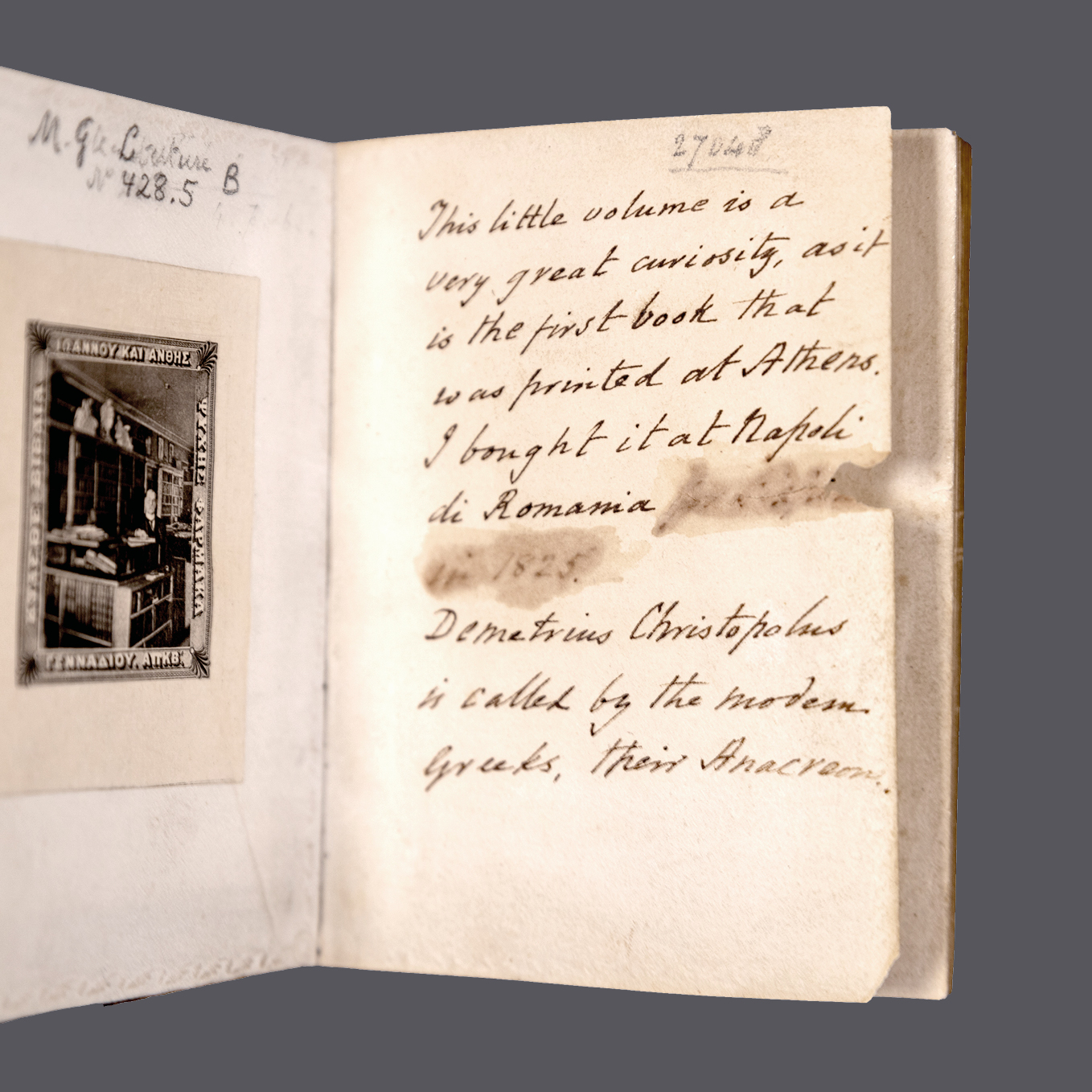
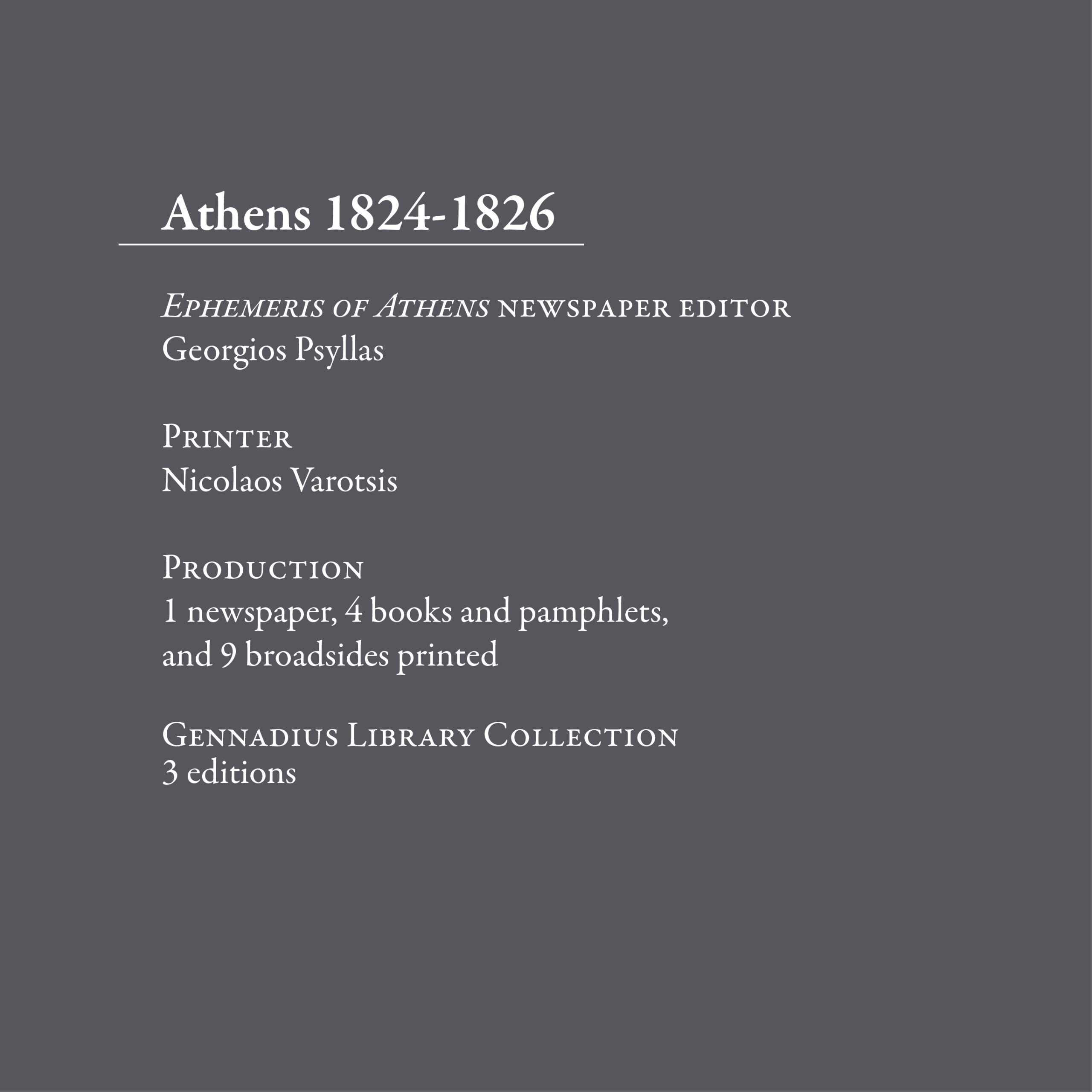
The Phanariote politician Theodoros Negris established another revolutionary administrative organization in Athens, the Areopagus of Eastern Continental Greece. He died in 1824, the same year that Stanhope decided to found a second printing press in Athens instead of Nafplion. Contrary to Mavrokordatos, Stanhope believed that the press had to be removed from the centers of administration and conflict. This printing house published a newspaper, the Newspaper of Athens (Εφημερίς των Αθηνών), with G. Psyllas as editor-in-chief. The printing equipment sent by Stanhope from Missolonghi was delayed for some time by Panos Kolokotronis and the press was eventually installed in Salamis, with Nicolaos Varotsis from Amphissa, who had learned the trade in Venice, as its printer. The announcement of the newspaper’s publication appeared on 6 July 1824, and the first issue was released on 20 August. The press was moved to Athens and then for a brief period to Salamis in May 1825, due to security concerns. It would eventually return to Athens, where it continued to function until August 1826, when Ottoman forces under Kütahi took the city. The printing house operated with one press and rudimentary equipment; it primarily served the administrative needs of the Athens Philomuse Society through the publication of four known books and pamphlets, and nine broadsides. The Athens printing house also published Athanasios Christopoulos’s Lyrics and Bacchics (Λυρικά και Βακχικά), a literary work completely unrelated to the other publications.
![Ἐφημερὶς Ἀθηνῶν [Ephemeris of Athens], G. P. [Georgios Psyllas]. Athens: Paza N. Vazotzis, 1824 – 1826. The first newspaper to be published in Athens, with Georgios Psyllas as editor-in-chief. The “Announcement” of its publication was circulated on 18 July, 1824, while the first issue following on 20 August 1824. Initially printed in Salamina, printing operations soon moved to Athens. The newspaper was printed on a press gifted to the Athens Community by the representative of the London Philhellenic Committee, lieutenant-colonel Leicester Stanhope. It ran for a total of 140 issues.](https://greekrevolutionprinting.gr/wp-content/uploads/2022/02/PHOTOS-ATHENS.jpg)
![Ὁμιλία Παραινετική. [Paraenetic Sermon]. By Talantiou Neophytos, Vicar of Athens and Livadeia. April 1826. [Printed at the Athens Printing House]. Broadside. A sermon written by Neophytos Metaxas, exhorting the faithful to dedicate their Sundays to the worship of God. Neophytos (Nicolaos Metaxas or Talantiou Nephytos, 1762-1861) studied under the Athenian Hellenist Ioannis Benizelos and the Epirote mathematician Ioannis Vodas. He was ordained bishop of Atalanti in Livadeia in 1803. He played an active role in the Revolution, becoming head of the Seat of Thermopylae in 1823, and Vicar of the province of Athens in May of the same year.](https://greekrevolutionprinting.gr/wp-content/uploads/2022/02/PHOTOS-ATHENS2.jpg)
![Τὰ Λυρικὰ καὶ Βακχικὰ τοῦ Αθανασίου Χριστοπούλου. [Lyrics and Bacchics] by Athanasios Christopoulos. Athens Printing House, 1825. Sixth edition of the Lyrics poem collection. On the title page it bears a quote of Spyridon Trikoupis: “The nation shall never succeed if it is not freed from the shackles of the puristic language.” Athanasios Christopoulos (1772-1847) was a judicial official, playwright, intellectual, poet, and member of the Philiki Etaireia, who became famous for his poetry and advocacy for vernacular (demotic) Greek. His Lyrics collection was exceedingly popular, seeing numerous editions after the initial Vienna edition of 1811. It was printed in 1825 in Athens on one of the printing presses brought by Stanhope, and is believed to be the first Greek book printed in Athens.](https://greekrevolutionprinting.gr/wp-content/uploads/2022/02/PHOTOS-ATHENS3.jpg)