


Printing was one of the most potent weapons the revolutionaries had at their disposal in 1821-1827. Six printing houses were established in the liberated regions of Greece, with the intent of supporting the struggle for liberty, and followed the seat of the Administration wherever it was transferred: Kalamata – Corinth, Missolonghi, Psara, Hydra, Athens, and Nafplion. Their operation was always connected with political and military developments.
In fact, three printing houses were established in administrative centers. The philhellenes’ contributions in funds and expertise proved invaluable to setting them up. Of the six printing houses, that of Kalamata was perhaps the most closely associated with the revolutionaries’ management of printed information. Alexandros Ypsilantis had proclamations of the revolution printed at the Greek printing house in Iasi, while his brother Demetrios Ypsilantis brought a printing press from Trieste to Kalamata, which he installed in an abandoned mosque near the gate of the fortress of the city. Its operation was brief. It was overseen by Konstantinos Tombras and Apostolos Nikolaidis from Kydonies, two printers who travelled to the Peloponnese from Psara, where they had sought refuge after the Turkish sack of their hometown.
In late 1821, the First National Assembly ratified the first Greek Constitution at Epidaurus and elected a government led by Alexandros Mavrokordatos, based in Corinth. Accordingly, the printing press was transferred there and continued to operate under Tombras and his assistants, eventually being supplemented with a second press from Livorno. The expedition of Dramalis and the Turkish conquest of Corinth put an end to the printing house in 1822.
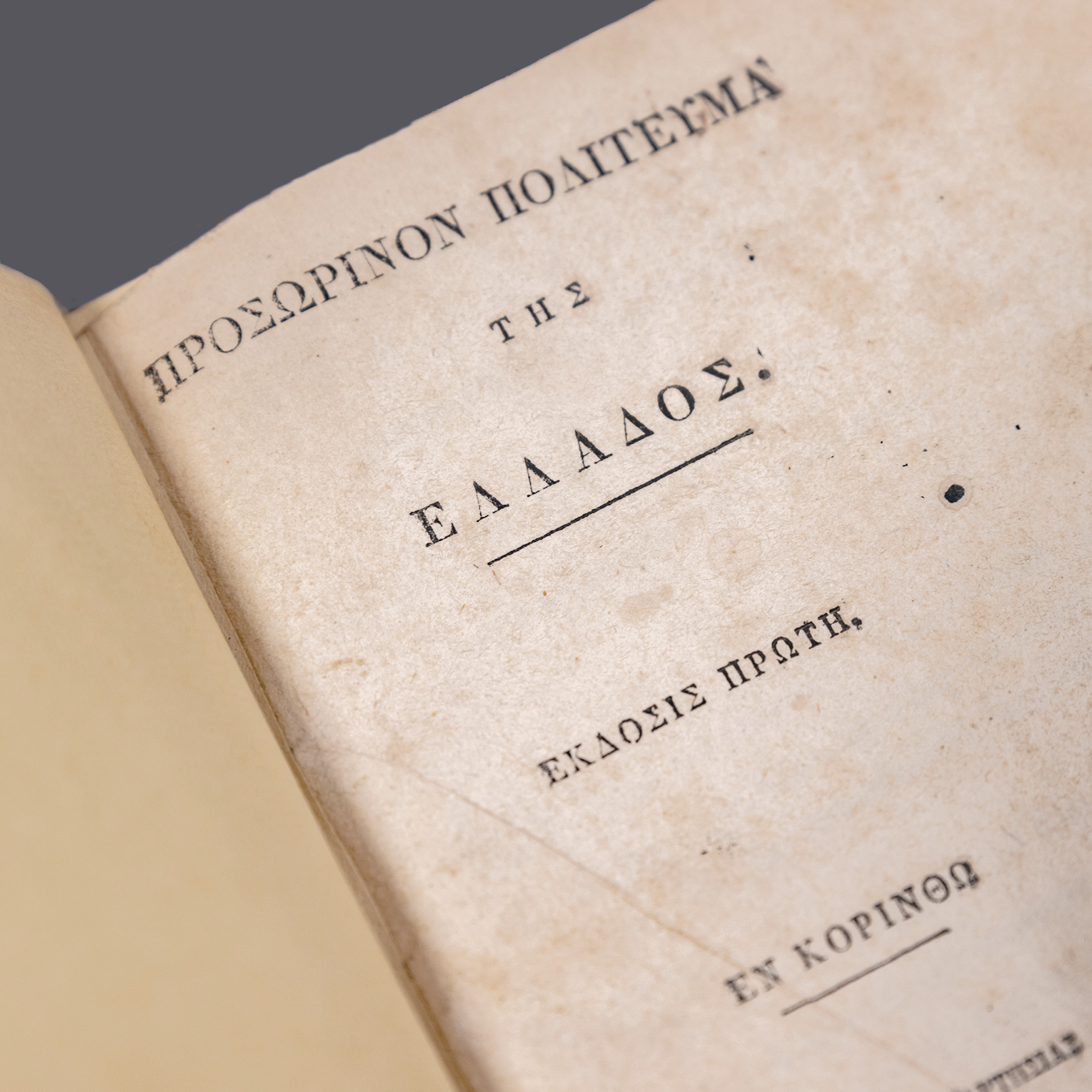
The first Greek newspaper, the Greek Salpinx (Σάλπιγξ Ελληνική) was printed in Kalamata. Its director, Theokletos Pharmakidis, resigned his post in protest over ongoing censorship after only three issues (1, 5, 20, August 1821). The Corinth printing house issued the first printed edition of the first Constitution of Greece (the Provisional Regime, Προσωρινόν Πολίτευμα) in 1822, in addition to thirty widely circulated broadsides.
In fact, three printing houses were established in administrative centers. The philhellenes’ contributions in funds and expertise proved invaluable to setting them up. Of the six printing houses, that of Kalamata was perhaps the most closely associated with the revolutionaries’ management of printed information. Alexandros Ypsilantis had proclamations of the revolution printed at the Greek printing house in Iasi, while his brother Demetrios Ypsilantis brought a printing press from Trieste to Kalamata, which he installed in an abandoned mosque near the gate of the fortress of the city. Its operation was brief. It was overseen by Konstantinos Tombras and Apostolos Nikolaidis from Kydonies, two printers who travelled to the Peloponnese from Psara, where they had sought refuge after the Turkish sack of their hometown.
In late 1821, the First National Assembly ratified the first Greek Constitution at Epidaurus and elected a government led by Alexandros Mavrokordatos, based in Corinth. Accordingly, the printing press was transferred there and continued to operate under Tombras and his assistants, eventually being supplemented with a second press from Livorno. The expedition of Dramalis and the Turkish conquest of Corinth put an end to the printing house in 1822.
The first Greek newspaper, the Greek Salpinx (Σάλπιγξ Ελληνική) was printed in Kalamata. Its director, Theokletos Pharmakidis, resigned his post in protest over ongoing censorship after only three issues (1, 5, 20, August 1821). The Corinth printing house issued the first printed edition of the first Constitution of Greece (the Provisional Regime, Προσωρινόν Πολίτευμα) in 1822, in addition to thirty widely circulated broadsides.
![Δια προσταγής του Υψηλοτάτου Πρίγκιπος Δημητρίου 'Υψηλάντη πληρεξουσίου [By order of His Highness Prince Demetrios Ypsilantis, representative]. Kalamata, 1st September, 1821. Travel order from the Kalamata printing press – the only known copy. The name and destination have been filled in by hand: it orders a certain Constantinos Vallianos to go from Kalamata to Trikorypha [Trikorpha]. Signed by P. Paraskevas.](https://greekrevolutionprinting.gr/wp-content/uploads/2022/02/PHOTOS-KORINTHOS-KALAMATA.jpg)
![Προσωρινὸν πολίτευμα τῆς Ἑλλάδος. [Provisional Regime of Greece]. 1st Edition. Corinth, 1st year of Independence 1822 The first edition of the first constitution of the free state of Greece. It had been preceded by the Ionian Constitutions (1800, 1803 & 1817) and the local constitutions of the Peloponnese, Eastern and Western Central Greece (1821).](https://greekrevolutionprinting.gr/wp-content/uploads/2022/02/PHOTOS-KORINTHOS-KALAMATA2.jpg)

![Προσωρινὴ Διοίκησις τῆς Ἑλλάδος [Provisional Administration of Greece. The President of the Executive to the inhabitants of the Islands of the Aegean Sea and the Sporades. Corinth, 23 April 1822. The President, A. Mavrokordatos. The Chief Secretary of State, Minister of Interior Affairs, Th. Negris]. The National Assembly that convened at Epidaurus announces the appointment of committees from the islands. The names are handwritten: the most wise and learned member of parliament, Mr. Benjamin of Lesbos, Mr. Nicolaos Economou from Hydra, the minister of Justice, doctor Konstantinos Metaxas, Mr. Vasileios Nicolaou Ginis.](https://greekrevolutionprinting.gr/wp-content/uploads/2022/02/PHOTOS-KORINTHOS-KALAMATA5.jpg)